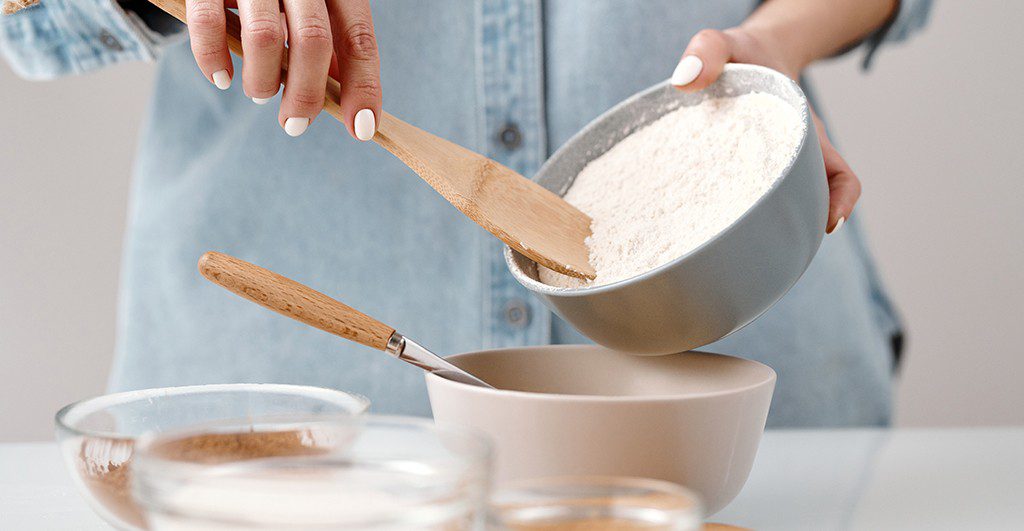
In this article, you'll learn how to measure flour without a scale. Are you visiting a friend's house who doesn't have a scale, or is yours simply broken? Read on, and we'll show you how easy it is to weigh flour without a scale.
Weigh flour with a spoon
Yes, you can measure flour with a simple tablespoon. Keep in mind that a a heaped spoonful of flour corresponds to approximately 20 grams of flour. So 100 grams correspond to 5 heaped tablespoons.
Weigh flour with a teaspoon
If necessary, you can weigh the flour with a teaspoon. teaspoon corresponds to approximately 10 grams of flour. For small quantities, it is the most precise method among those without a scale.
Weigh flour with a plastic cup
Desperate times call for desperate measures: if you don't have a scale to weigh the flour, you can also use a simple plastic cup. A white plastic cup of approximately 200 ml corresponds to approximately 130 grams of flour.
Weigh flour with a breakfast cup
A standard 250ml breakfast cup filled with flour is approximately 150-160 grams, depending on the type of flour and how much it is leveled. This method is very practical for recipes that require quantities around 150 g.
Quick Reference Table
Here's a summary table for measuring flour without a scale:
- 1 heaped teaspoon = approximately 10 g
- 1 heaped tablespoon = approximately 20 g
- 5 tablespoons = approximately 100 g
- 200ml plastic cup = approximately 130 g
- 250ml breakfast cup = approx. 150-160 g
Note: The values indicated refer to type "00" soft wheat flour. Whole wheat, corn, or spelt flour may have slightly different densities.
Practical tips for measuring without a scale
To get more accurate measurements without a scale, follow these tips:
- Always use the same container as a reference throughout the recipe
- Level the flour with a spatula or the back of a knife to have more uniform measurements.
- Do not sift the flour before measuring it, because sifting reduces the density
- For pastry preparations where precision is crucial, it is always better to use a scale
Did you know that the history of flour has ancient origins? Flour was invented thousands of years ago and is almost indispensable for everyday preparations. Also check out our article on flour. History of flour ".